


➤ Nuovi Mondi, Detail
A Constellation of Molecules: A New Self Takes Shape from Fragments
“We are made of star stuff.” With this line in the landmark documentary series Cosmos: A Personal Voyage, astronomer Carl Sagan invited viewers to reconsider humanity’s relationship with the universe. From birth, infants use sensory experience to explore the boundary between themselves and their surroundings, gradually developing self-awareness as they grow. Once the distinction between self and other becomes established, we learn to see ourselves through other people’s eyes and to care about how we are perceived. Yet we often forget that many of the elements that make up our bodies are also present throughout the natural world and the wider cosmos. For Italian artist Micaela Lattanzio, the boundaries between the individual and the whole, and between self and other, are never absolute. Through dynamic, mosaic-like works, she challenges the entrenched assumption that the body and identity are fixed forms.

➤ Nuovi Mondi, 2025, 108 cm
Beyond the Surface: The Body in Molecular Form
With social media woven into daily life, we inhabit a culture shaped by labels, aesthetic norms and digitally mediated relationships. Outward appearance has become an almost unavoidable way of communicating who we are and responding to how others define us. Yet the face and body are only the surfaces through which we are socially recognised and onto which ideas of identity are projected. They do not always correspond to our inner sense of self. For Lattanzio, fragmentation is a necessary transition. Cutting into the photographic image of the body calls its closed form, fixed contours and apparent stability into question. At the same time, deconstruction creates the possibility of reconstruction. Once the image is broken into fragments, it does not disappear. The pieces acquire a spatial presence, catch the light and change with movement. Reassembly does not restore the original image. It creates a new configuration that is more open, more dynamic and less bound to a fixed idea of identity.

➤ Production Process
Lattanzio therefore imagines the body as an ever-changing “constellation of molecules”, capable of extending beyond its physical limits, embracing the flow of life and renewing its connection with the world. Lattanzio’s language of “molecular fragmentation” draws on the traditions of sculpture, fresco and mosaic in her native Rome. It also brings together photography, which has served as a visual diary since childhood, with her study of painting and mosaic techniques. In 2008, she first conceived and tested a process of cutting photographs by hand into fragments and reassembling them so that the flat image acquired three-dimensional form and material presence. The process later became central to her practice. The placement, scale and colour of the fragments are guided by intuition and a painter’s eye. Colour directs the viewer’s gaze. Dense clusters build visual tension, while open areas give the composition room to breathe. In the Nuovi Mondi series, compositions are assembled from fragments of satellite imagery of Earth. Up close, roads, cities and other geographical details remain legible. From a distance, the same forms resemble cells, moulds or lichens under a microscope. Lattanzio is drawn to this ambiguity between planetary and microscopic scales. The source material is unmistakably terrestrial, yet the resulting forms evoke both microscopic life and deep space.

➤ Artis | Micaela Lattanzio

➤ Artis | Micaela Lattanzio

➤ Lattanzio, Cosmogonia, 2019

➤ Biophilia, Dittico, 2020
Through the Lens: Photography as Slow Writing
In an image-saturated age, we take in visual information faster than we can properly absorb it. We do not always process or retain what we see, let alone turn it into thought. The result is a “fragmented visual alphabet” made up of memories, impressions and scattered images, one that reshapes how we perceive reality. Photography offers Lattanzio a different rhythm. She uses the camera as a form of writing, a way to narrate, collect and archive the world. Her relationship with the medium began in childhood, when her father gave her an analogue camera. Photography became a personal language, teaching her to observe, compose and find the image before pressing the shutter.

➤ La Natura Inquieta, 2021
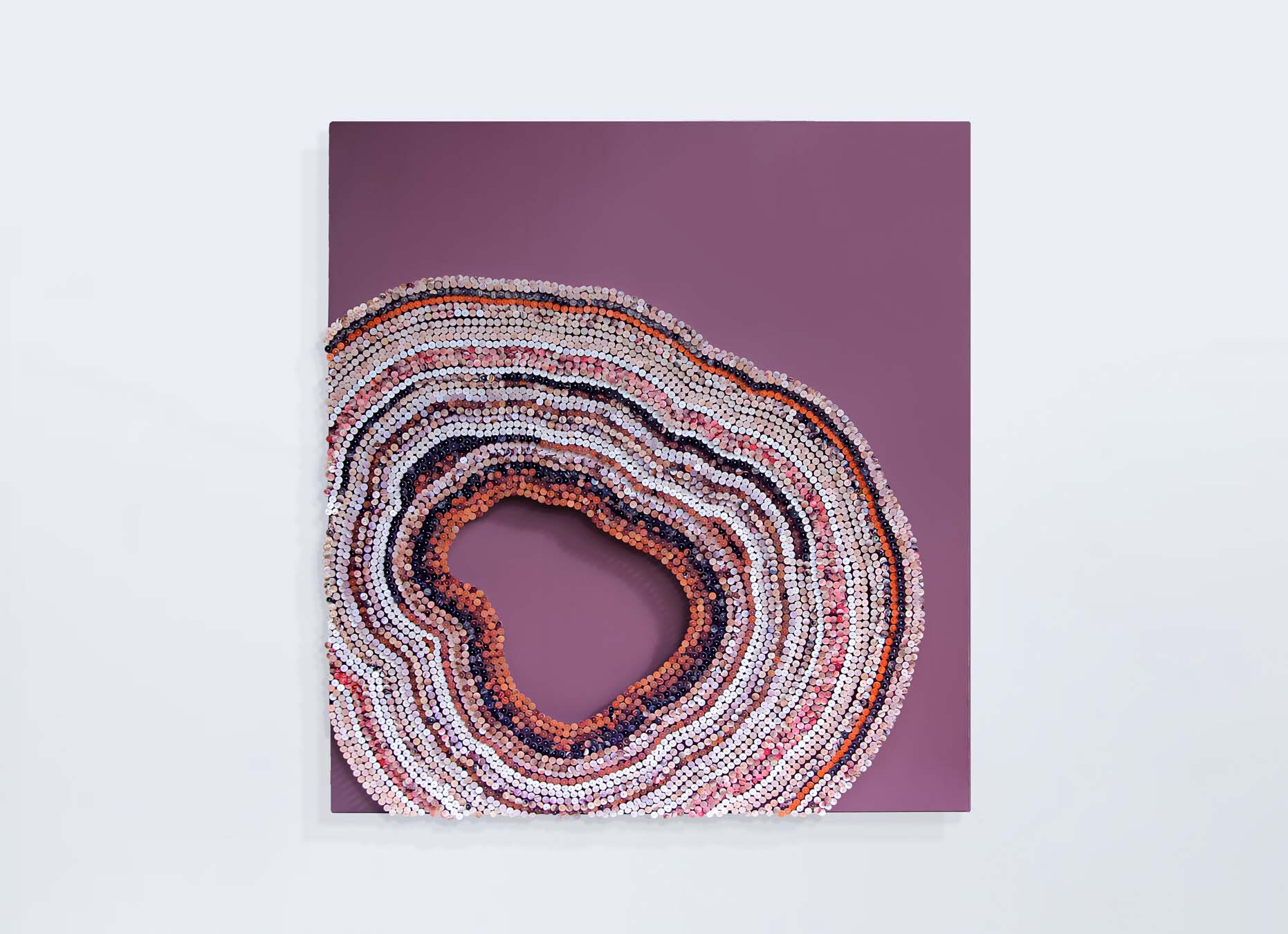
➤ La Natura Inquieta, Nucleo, 2024 110 x 120
Lattanzio is most inspired by places in constant flux, where the world continues to change beneath an appearance of stillness. She has chosen to live near Rome, with the coast, green spaces and countryside close by. The openness of the landscape helps her thoughts settle and restores a sense of inner quiet. Most often, she takes her camera outdoors and works in silence, listening to what surrounds her. She moves slowly, in a state of suspended attention, observing light, colour, form and the ceaseless rhythms of life. When a project begins with a specific idea, she photographs with clear intent. SandCloud, for example, is a floor installation made from photographs of the sky taken in different places and seasons, then cut into fragments and reassembled. Lattanzio spent about a year gathering material and observing the sky’s constant changes. For this work, her photographic intuition came before the concept had fully formed. For Lattanzio, photography begins with this slower form of attention, when the world is no longer merely observed but fully experienced.

From the Self to the Living World
“Awareness begins when we truly start to perceive ourselves within the world, not separate from it,” says Lattanzio. Contact with nature, she believes, sharpens our sense of time and our awareness of the body in space. It develops physical agility, strengthens our capacity to listen and observe, and cultivates care for what surrounds us. The same concern with the relationship between body and world runs through Fragmenta. Drawing on her private experience of living with undifferentiated connective tissue disease, Lattanzio uses hexagonal fragments to extend the body’s apparent boundaries and give form to a hope for healing and release. For years, she chose not to speak publicly about this experience, preferring to leave the work open to interpretation. In doing so, she invites viewers to remain critically engaged while entering a more introspective mode of looking. At a time when identity is closely intertwined with digital life, Lattanzio remains open to technology as a research tool, yet continues to cut, select and arrange images by hand. The slow, physical process becomes a way of looking beyond outward appearance towards a deeper sense of self. She hopes this slower way of making can remind us that a healthy society is more than a productive one. It also depends on the relationships we sustain with the world around us.

➤ Production Process