


➤ Photography | Tian Fang Fang
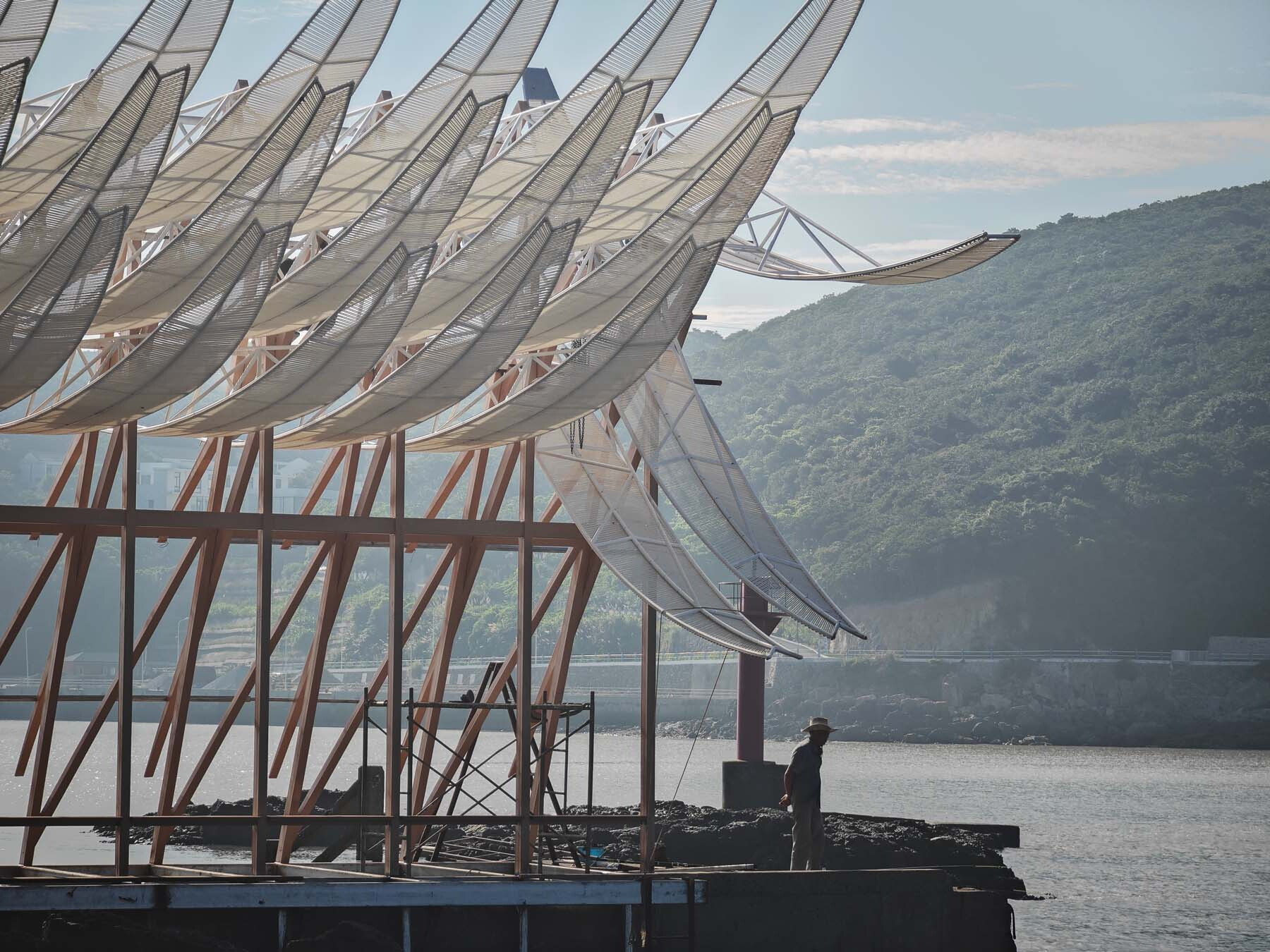
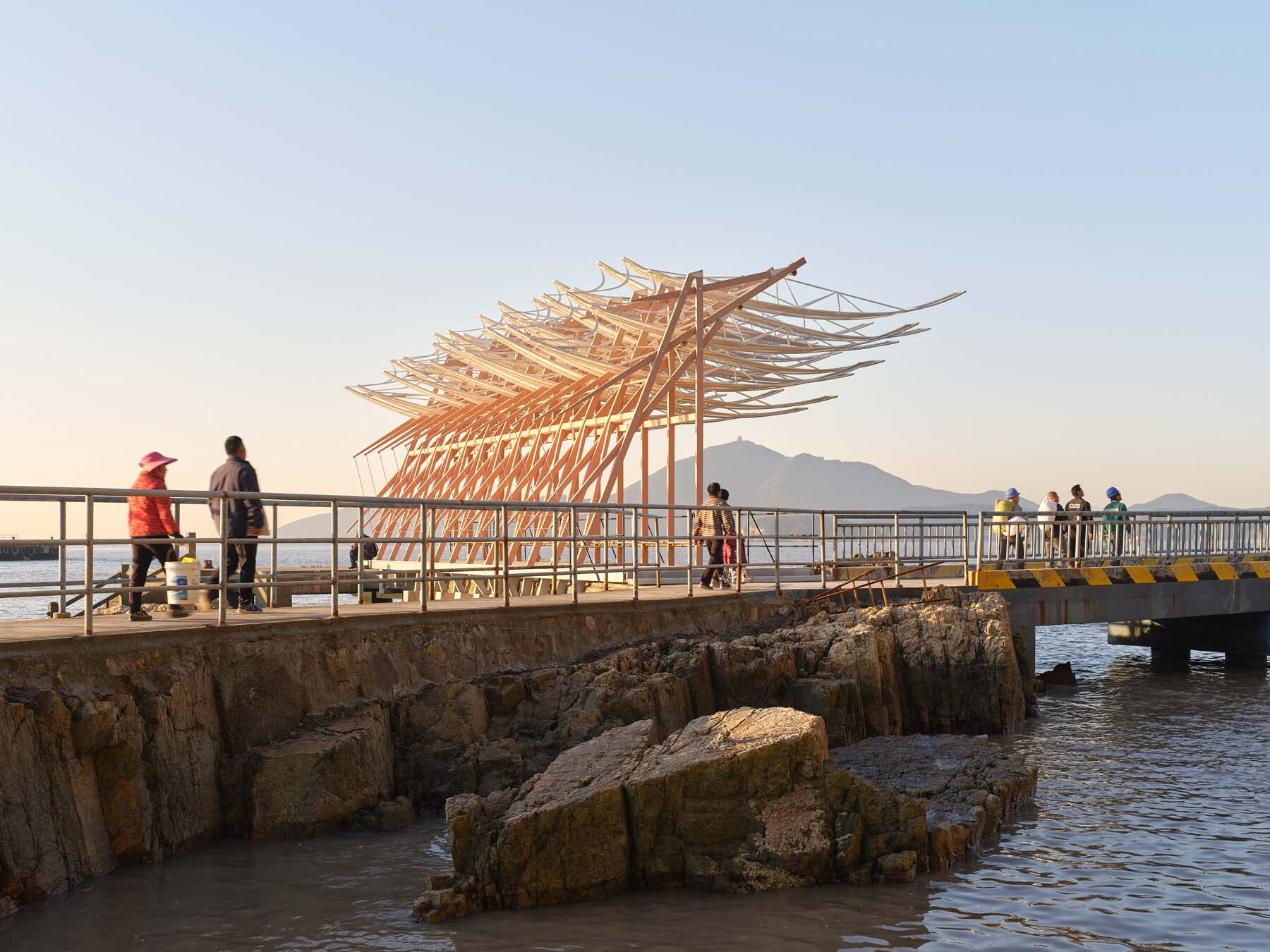
To stand amid towering mountains with a surging sea ahead is both awe-inspiring and humbling. The scale of the landscape can momentarily blur the boundaries of the self, inspiring reverence yet also a sense of distance from the natural world. In a landscape of this scale, an art installation can mediate perception by drawing on elements of its surroundings and translating invisible phenomena into visible traces. It gives otherwise indistinct feelings a point of reference and guides the senses into a silent dialogue with earth and sky. GN Architects’ Seaside Pavilion on Chaishan Island in Zhoushan comes into view from a kilometre away as travellers sail towards Baisha Island or approach Chaishan Island’s pier. Slender blades hang like white wings from its elongated steel frame, swaying slowly in the sea breeze, their motion echoing the rise and fall of the waves. Watching them, visitors may find themselves breathing with the wind, quietly attuned to the island.

➤ Photography | Tian Fang Fang
Time passes and places change, often leaving a lingering sense of melancholy. Once densely wooded, Chaishan Island later prospered as fishing flourished. Following the decline of local resources and the departure of younger, working-age residents, fewer than 100 older residents now live on the island year-round. In recent years, the city of Zhoushan has launched the “Hello, Island” common prosperity initiative to promote fisheries-based tourism and ecological restoration. Art, in particular, has helped bring people closer to the island. After surveying the island several times, GN Architects selected a disused cargo pier dating from the 1960s as the site for their creative intervention. Their proposal, “Seaside Pavilion,” ultimately won first place in the competition and was subsequently brought to realization. The project evokes the mood of the Chinese lyric Bu Suan Zi: “Through the ages, wayside pavilions near and far have marked places of farewell and welcome. People from east, west, north and south have grown old; beneath the pavilion, the tide remains as ever.” Set amid jagged rocks, blue sky, mountains and sea, the installation welcomes those arriving and sees off those leaving, opening a new chapter in the revival of an ageing island.
➤ Photography | Liang Wen Jun

➤ Photography | Liang Wen Jun

➤ Photography | Liang Wen Jun
➤ Photography | Zhang Yong
Because most visitors remain on Chaishan Island only briefly, the pavilion was conceived as a visual marker at the island’s entrance that could engage them immediately. The original proposal would have used the rise and fall of the tide to move a series of floats, which in turn would have operated the overhead blades through cables and pulleys. The team eventually replaced this system with one driven by the sea winds that blow across the island year-round. This removed the several-hour delay imposed by the tidal cycle and allowed the installation to respond immediately. Its form was consequently revised into a lighter, highly porous array of wind-driven wings, each comprising a steel frame finished with a corrosion-protective coating and wrapped in high-strength fishing rope. As they move, the wings become part of the island’s natural rhythm. The pavilion may appear to move effortlessly in the wind, but its transport and assembly were time-consuming, and the team had to make continual fine adjustments on site as weather conditions changed.

➤ Photography | Liang Wen Jun
As GN Architects recounts, transporting the prefabricated components from the factory across the sea to Chaishan Island for assembly was a considerable undertaking in itself. The pavilion comprises 36 semi-transparent blades, each seven metres long and arranged in groups of three. Each blade is connected to the main structural frame by a bearing. Dynamic simulations in Grasshopper were used to determine its range of motion. At the tail of each blade, a primary counterweight balances the moment generated by the cantilevered front section, while a secondary counterweight fine-tunes its resting angle in still air. The blades move gently even in Beaufort Force 3 winds. Linkages and rubber limit stops restrict their maximum travel, preventing collisions and damage. Before a typhoon, the blades can be secured to the main structure to reduce the risk of storm damage. Like the people of Gangli, the installation lives with the sea day after day, greeting each group of visitors in the breeze and quietly bringing new life to the island.

➤ Photography | Liang Wen Jun

➤ Photography | Liang Wen Jun

➤ Photography | Liang Wen Jun
