太行新宇美術館
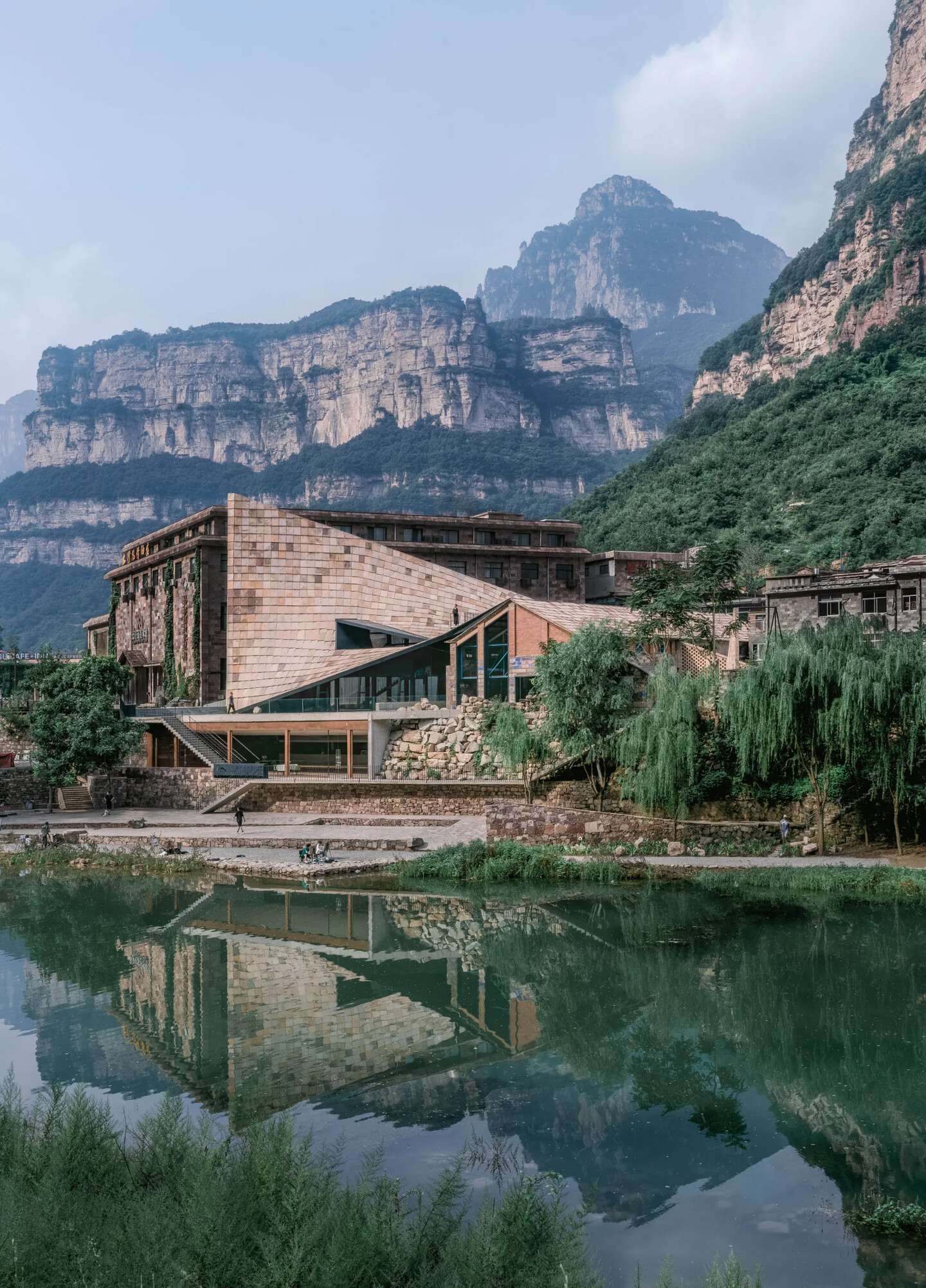
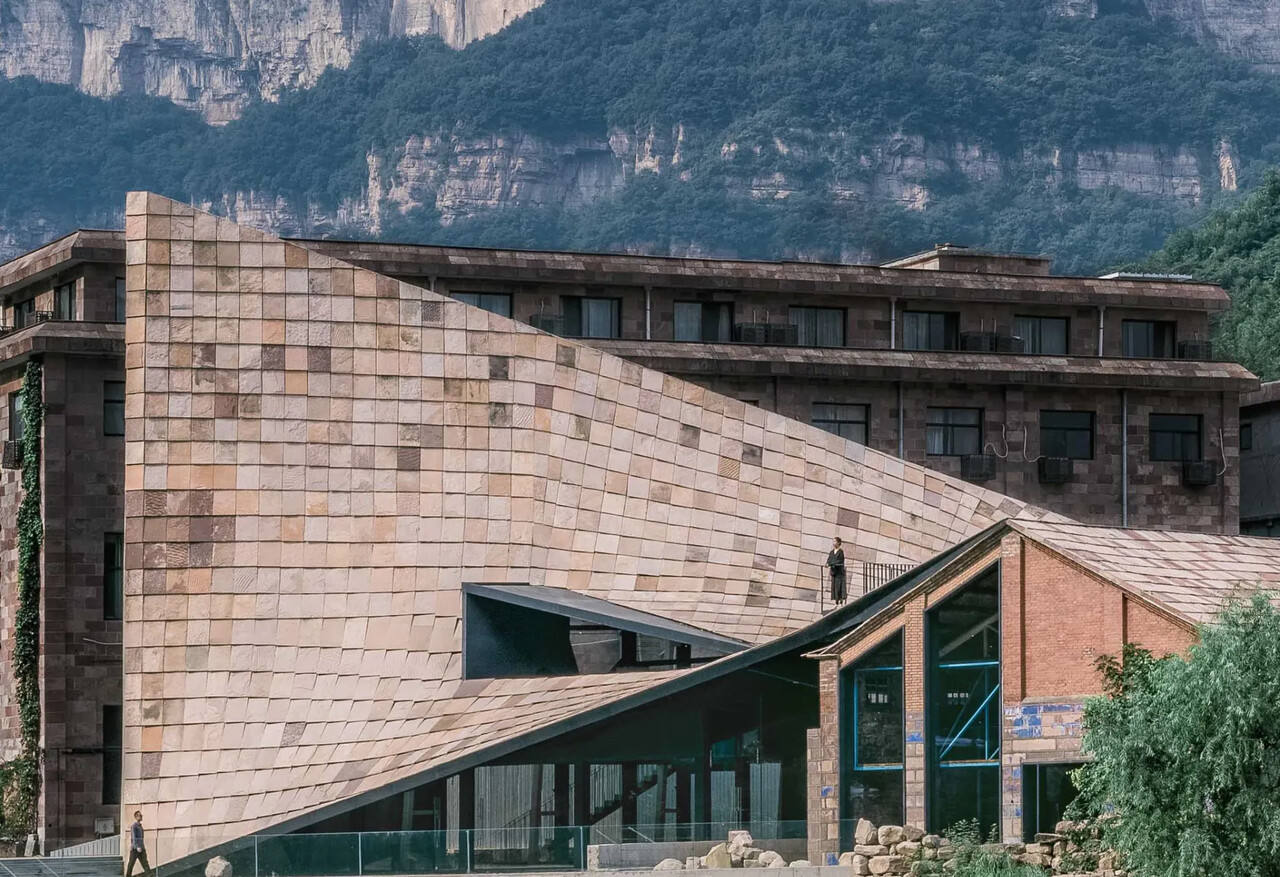
太行新宇美術館鑲嵌於林州石板岩鎮街巷之中,背靠太行,面對蒼溪。建築修補村鎮肌理,活絡舊有倉庫,活化山水界面,猶如從山水中生長而出,在局促的場地裡,實現新舊銜接與融合。可持續地再利用當地舊有石材,活化傳統石造工藝,營造出多層級的公眾開放空間。
在河南安陽林州石板岩鎮太行山段,沿著溪邊公路行駛,直立的崖壁,刀劈斧削,撲面而來。郭熙畫論《林泉高致》山水訓中有云,「太行枕華夏,而面目者林慮」,此處可謂顏值擔當。石板岩鎮地處太行大峽谷風景區,近年來正以「中國畫谷」的定位,晉升為北方最重要的寫生基地。正是基於鄉村文旅振興的背景,一座具有標識性的美術館擬在鎮口建造。
為了避免利益、權利和權力制衡帶來的低效發展,一種政府、藝術家、社會資本三方合作的模式在此實踐,政策扶持下的美術館為大眾提供美育和文化福利、為林州竪立文化品牌;也為長期創作太行美景的藝術家孟新宇提供文化交流的客廳;亦為當地投資者提供文旅收入,以維持文化設施的運營。多元價值的塑造帶來可持續的長效發展。
Taihang Xinyu Art
Taihang Xinyu Art Museum is inlaid in the streets and alleys of Shibanyan Town, Linzhou, with its back against Taihang Mountain and facing Cangxi River. The architecture repairs the texture of the village and town, activates the old warehouses, and activates the landscape interface, as if growing out of the landscape, and realizes the integration of the old and the new in the cramped site. Sustainably reuse local old stone materials, revitalize traditional stone crafts, and create a multi-level public open space.
In the south Taihang Mountain near to Shibanyan Town, Linzhou, Anyang, Henan Province, driving along the road beside the stream, the upright cliffs, chopped with knives and axes, rush towards us. In Guo Xi's painting theory "Linquan gaozhi", there is a saying in the landscape training, "Taihang rests on China, and the face is Lin Lu", here it can be said that the appearance is responsible. Shibanyan Town is located in the Taihang Grand Canyon Scenic Area. In recent years, it has been promoted to the most important sketching base in the north with the positioning of "Chinese Painting Valley". It is based on the background of the revitalization of rural cultural tourism that an iconic art gallery is planned to be built in the entrance to the town.
In order to avoid the inefficient development brought about by the check and balance of interests, rights and power, a tripartite cooperation model of government-artist-social capital is practiced here. The art museum supported by the policy provides aesthetic education and cultural benefits for the public, and erects a building for Linzhou. It is a cultural brand; it also provides a living room for cultural exchanges for the artist Meng Xinyu, who has painted the beautiful scenery of Taihang for a long time; it also provides cultural tourism income for local investors to maintain the operation of cultural facilities. The shaping of multiple values brings sustainable long-term development.
從環境中生長出的「地標」
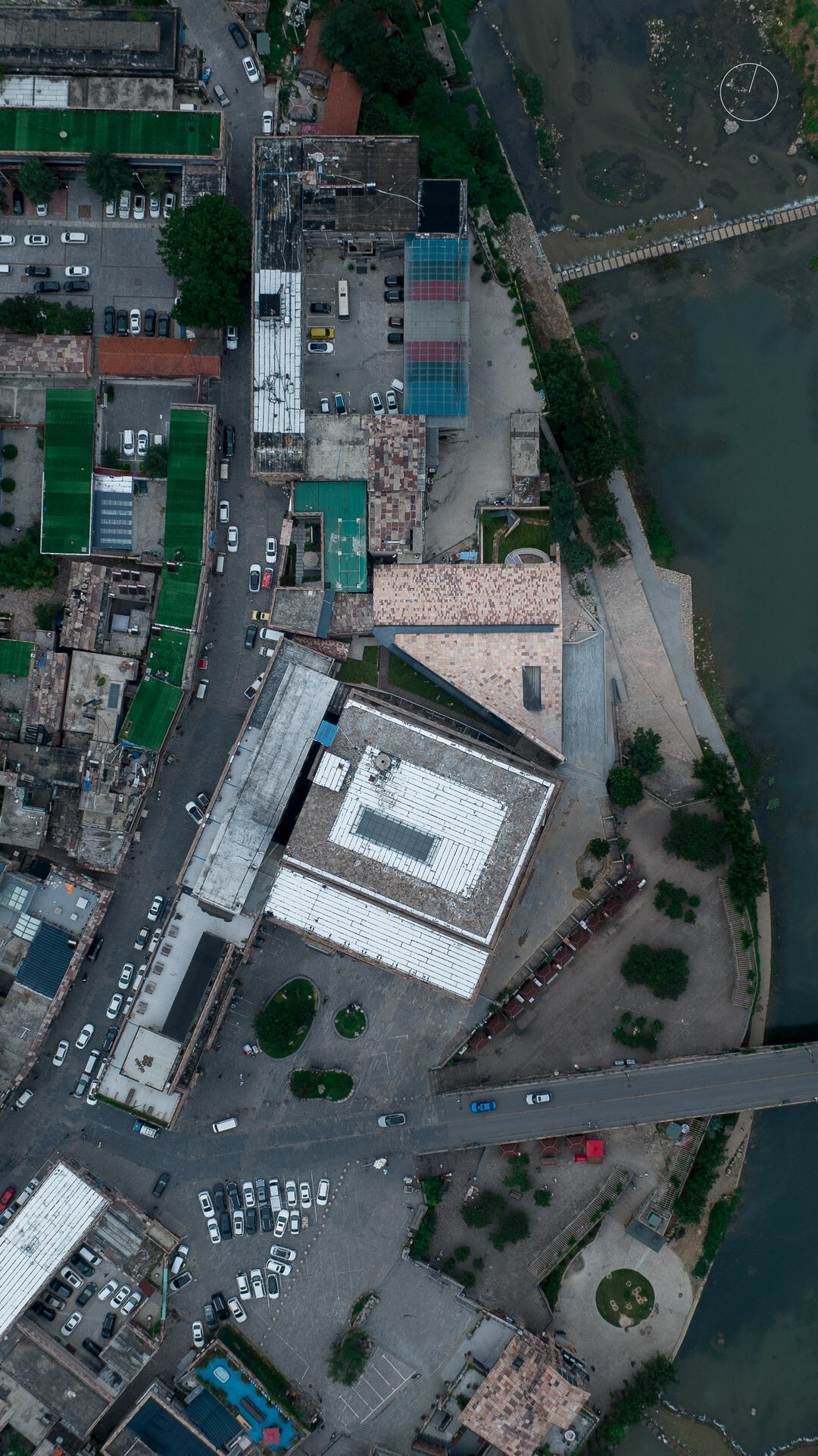
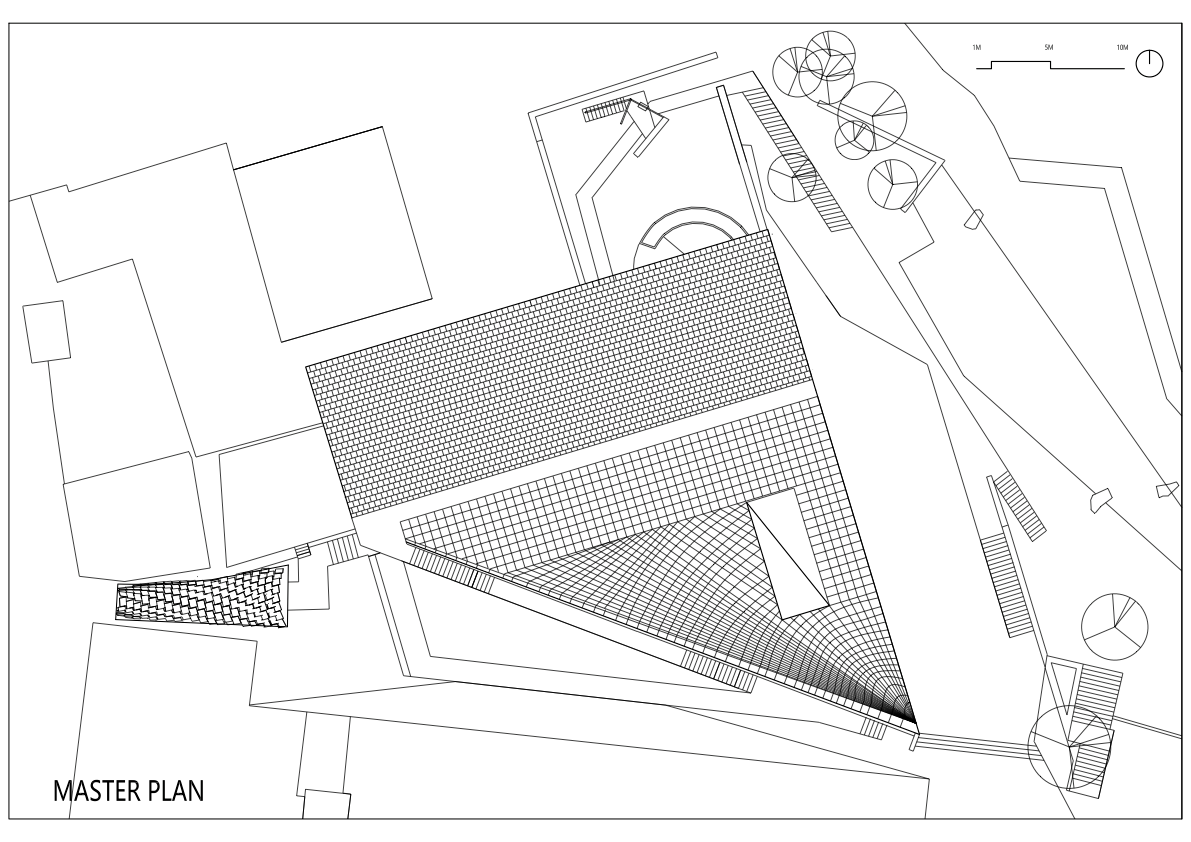
場地處於鎮口橋頭一隅,高矮建築環簇著這處三角形的地塊。有趣的是,場地南側的巨 大方盒子建築(供銷社、扁擔精神展覽館和賓館的復合體),和北側的坡屋頂倉庫(將被保留)暗示了美術館常見的兩種類型。
這座建築背負了塑造形象的符號編碼任務,在消費景觀的圖像中,美術館類型通常分為兩種,一是「冷漠的盒子」,白方空間(White Cube)是西方現代藝術展覽公共空間慣用的模式,從而將作品從日常生活經驗中剝離,使審美體驗在純粹、中性、明亮的異化「聖殿」中發 生。但在中國鄉村語境中,卻也往往成為空降的抽象符號。
選項二是採用鄉土符號,坡屋頂建築群滿足了文化懷舊的想象,似乎能實現傳承性的身份定位,然而,這在此地複雜的城鎮肌理中立刻失效,不同尺度的建築體量會將其淹沒,淪為刻板做作的表演,於是,我們嘗試不同的方式。
"Landmarks" grown from the environment
The site is at the corner of the bridge at the entrance of the town, and tall and short buildings surround this triangular plot. Interestingly, the huge square box building on the south side of the site (a complex of supply and marketing cooperatives, exhibition halls and hotels), and the slope-roofed warehouse on the north side (to be preserved) suggest two common types of art museums.
This building bears the symbolic coding task of shaping the image. In the images of the consumption landscape, the types of art museums are usually divided into two types, one is "indifferent box", and the White Cube is a public space for Western modern art exhibitions The customary mode, thus stripping the works from daily life experience, makes the aesthetic experience happen in a pure, neutral and bright alienated "temple". But in the Chinese rural context, it often becomes an abstract symbol of airborne.
The second option is to use local symbols. The buildings with sloping roofs satisfy the imagination of cultural nostalgia and seem to be able to realize the identity positioning of inheritance. However, this immediately fails in the complex urban texture here, and the building volumes of different scales will overwhelm it , reduced to a stereotyped performance. So, we tried a different approach.
實驗一種"新舊融合"的空間界面
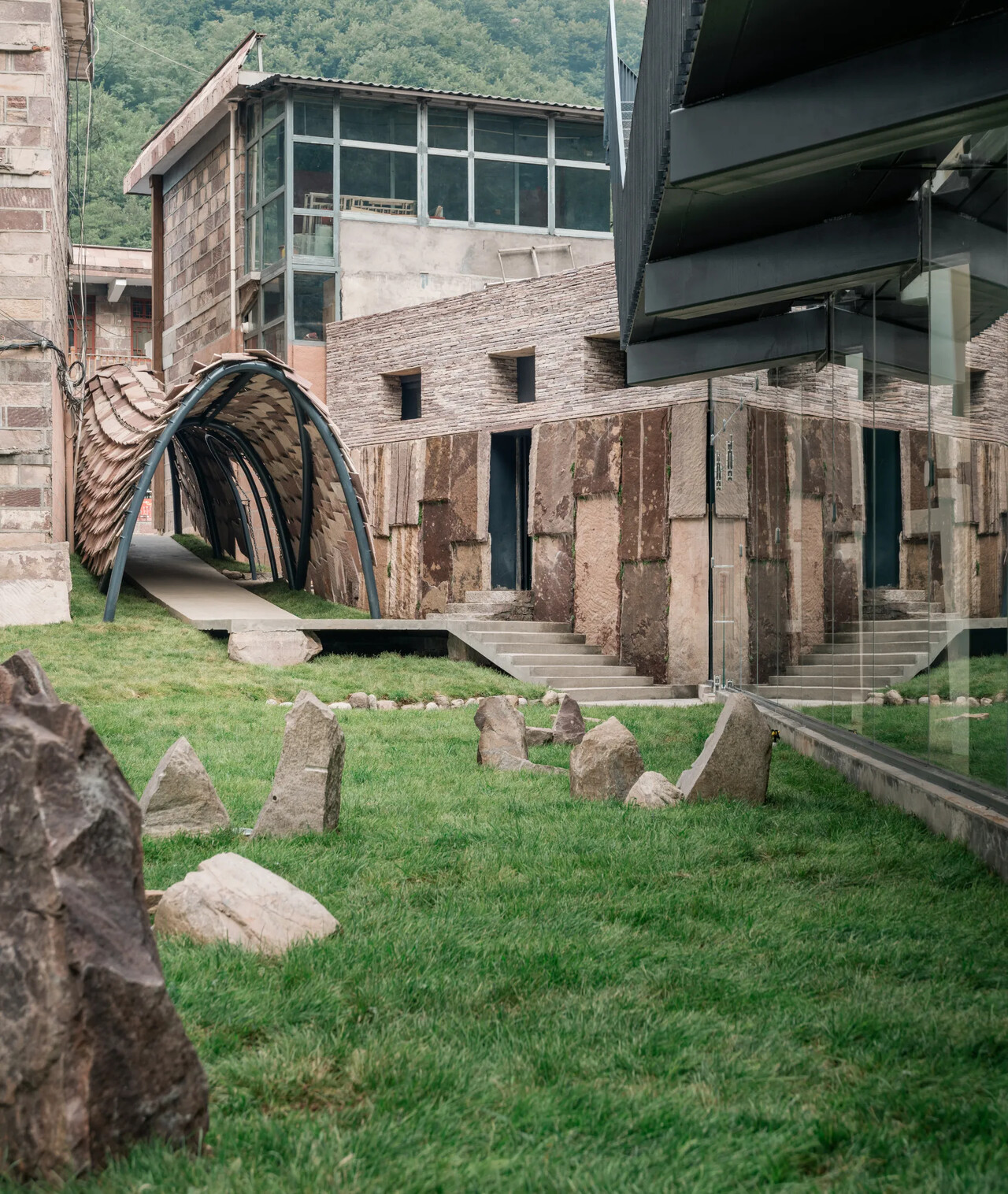
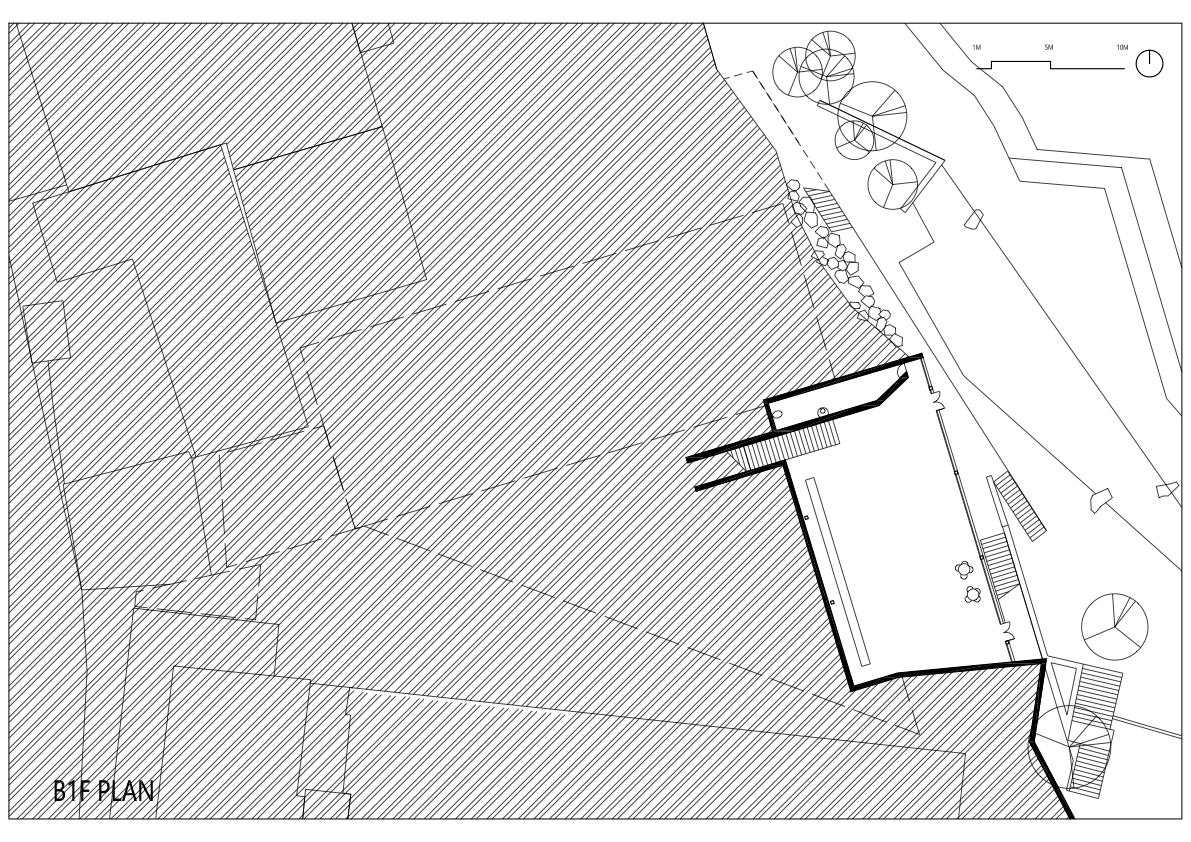
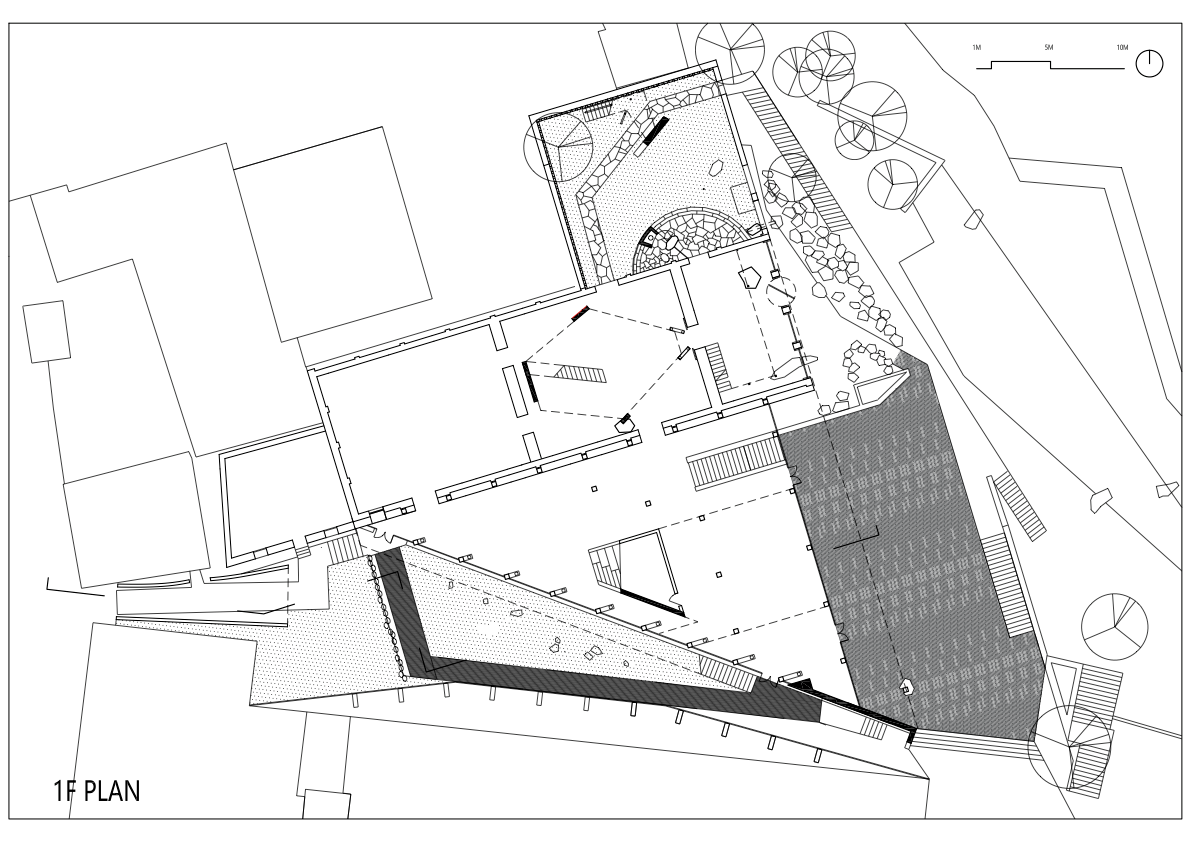
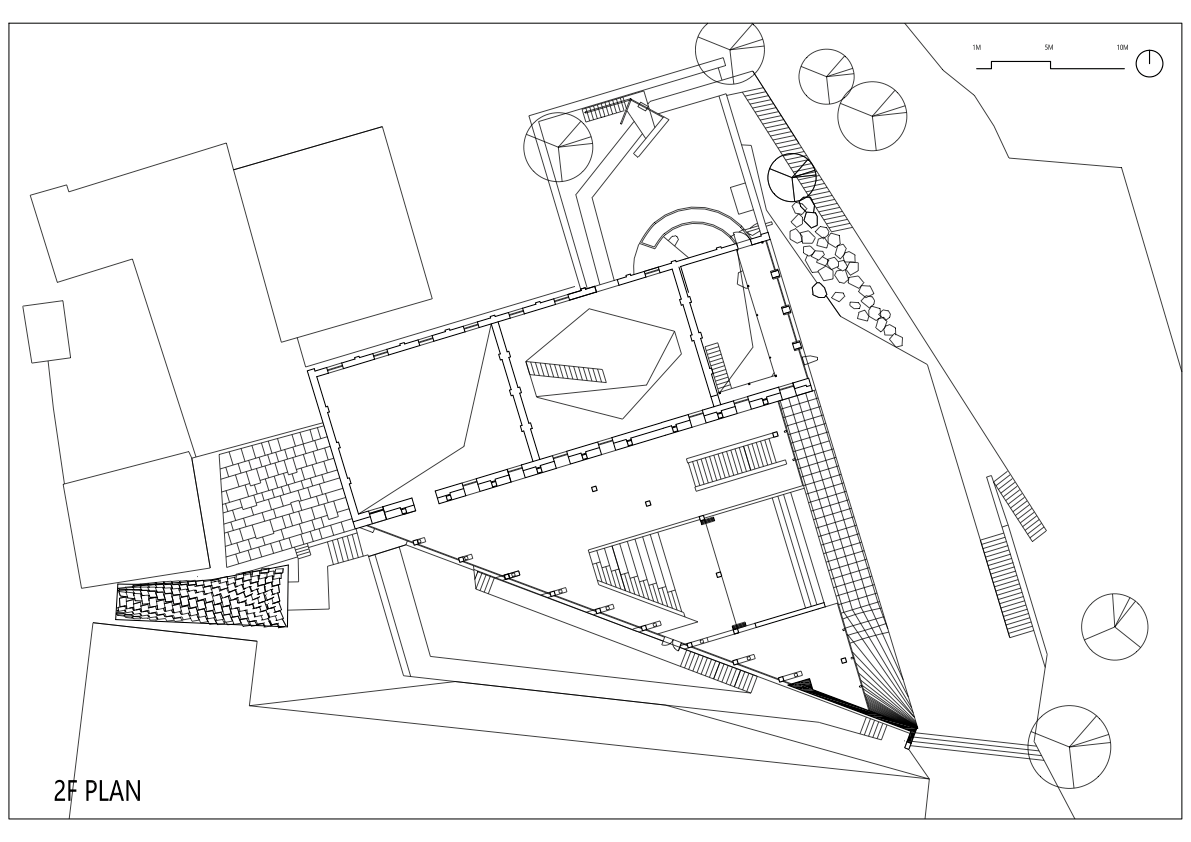
在房屋包圍下,這片三角形場地已經成為廚房排氣和公廁化糞的消極空間。為了滿足採光通風的要求,我們從中切出狹長的庭院,實現西側街道和東側水岸之間的人流聯繫,並將剩餘空間全部留給美術館,與北側的舊倉庫連為一體,實現小鎮肌理的縫合。
Experiment with a spatial interface that "combines old and new "
Surrounded by houses, this triangular site has become a negative space for kitchen exhaust and public toilet septic. In order to meet the requirements of lighting and ventilation, we cut out a long and narrow courtyard to realize the flow of people between the street on the west side and the waterfront on the east side, and leave all the remaining space for the art museum, which is connected with the old warehouse on the north side. Realize the stitching of the town texture.
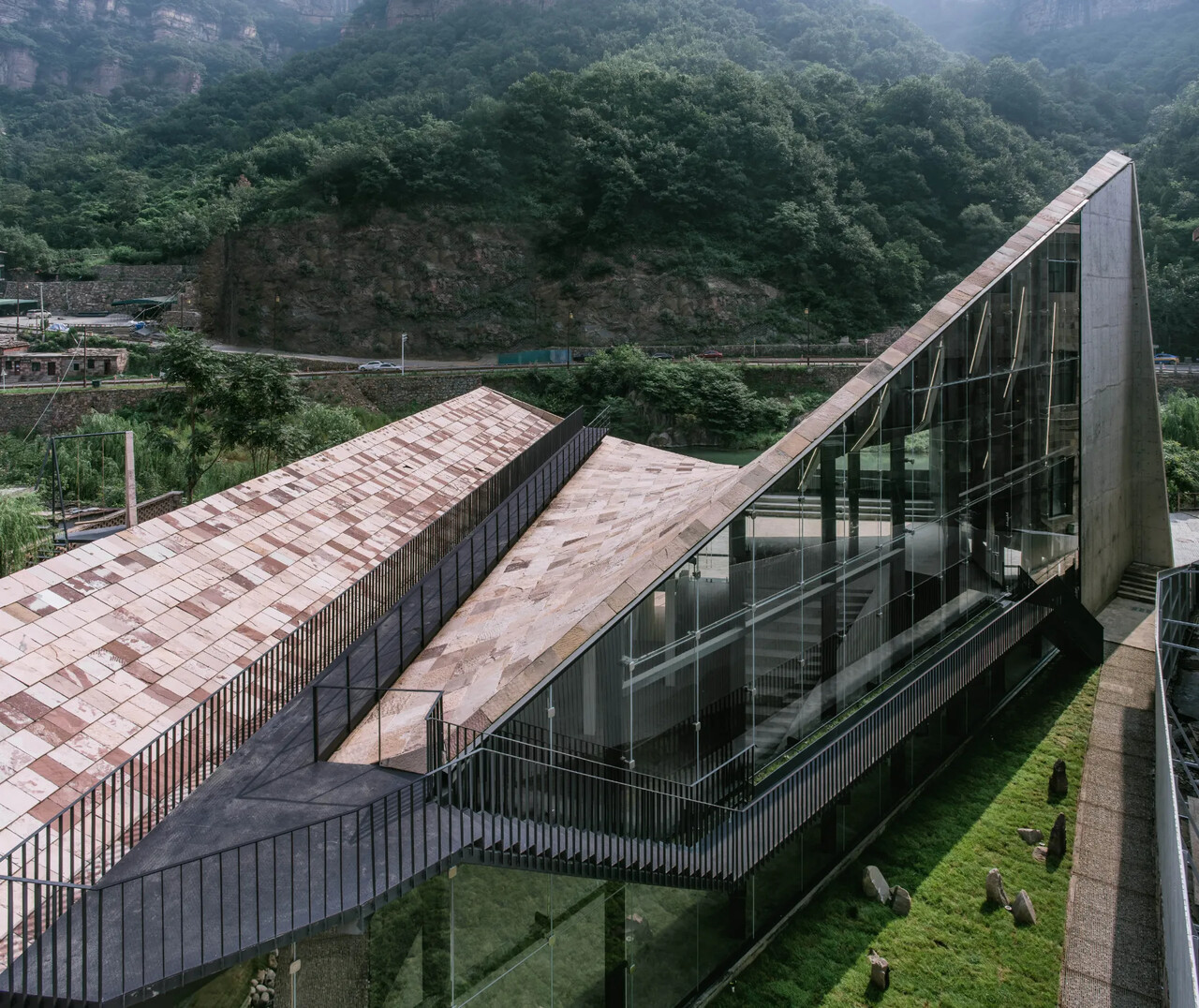
沿河界面成為設計的焦點,縱向上看,方正房屋的人工秩序和背後山體的自然有機秩序形成衝突,換言之,美術館應協調撲面而來的亙古大山和山腳下新興的人工城鎮。北宋範寬的《溪山行旅圖》給出答案,其畫面高山仰止,頂天立地,雄深蒼莽,壯氣奪人,而在近處則 是怪石箕居,大石橫臥於岡丘,石徑斜坡透迤於密林蔭底,山徑和溪流構成錯綜的體量。我們將美術館的界面定義為「多孔」而「傾斜」的近山,和之字形延展的曲折路徑,以之溝通蒼溪與遠山,創造層層後退的距離感,在高遠視圖中引發幽奧的深遠境界。
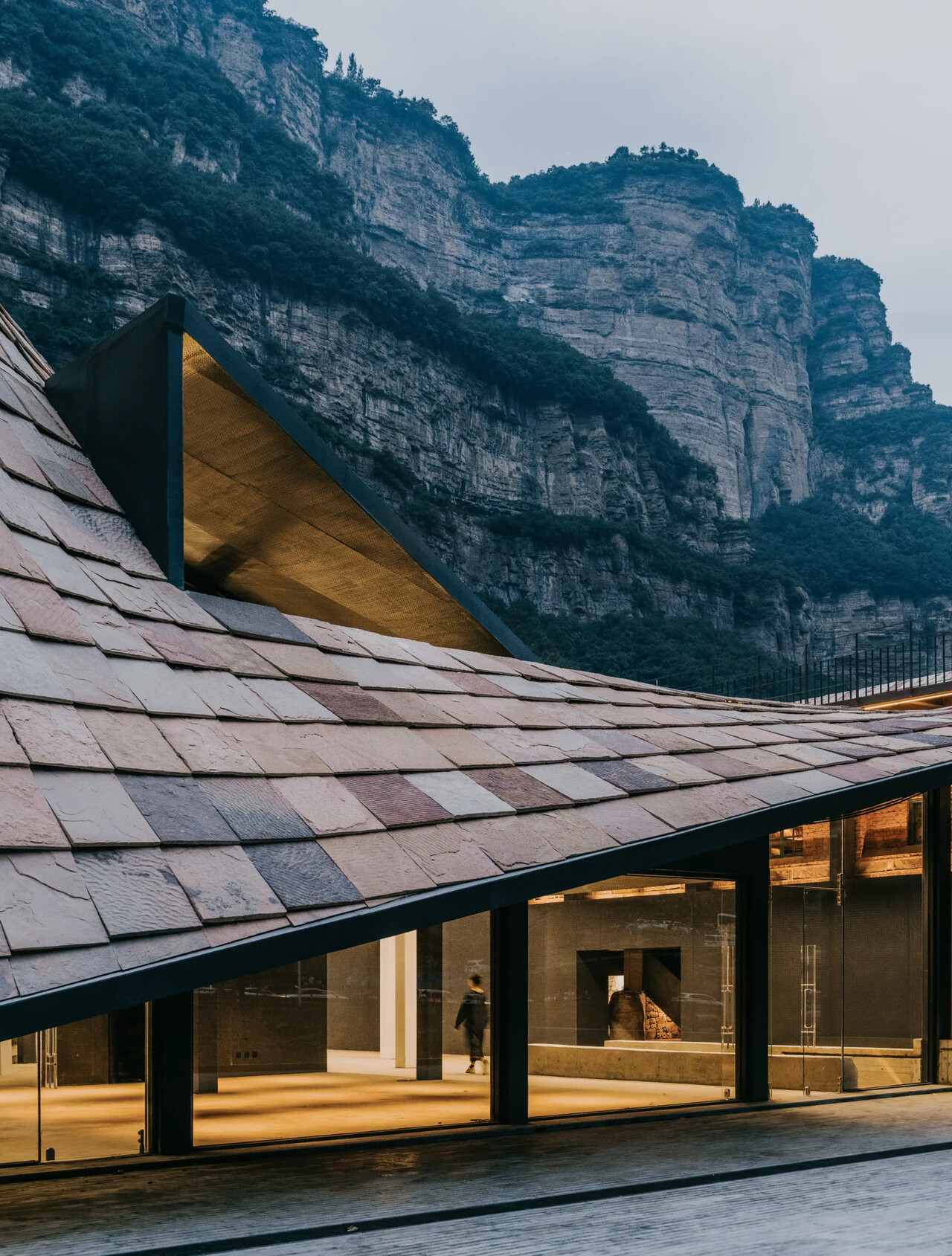
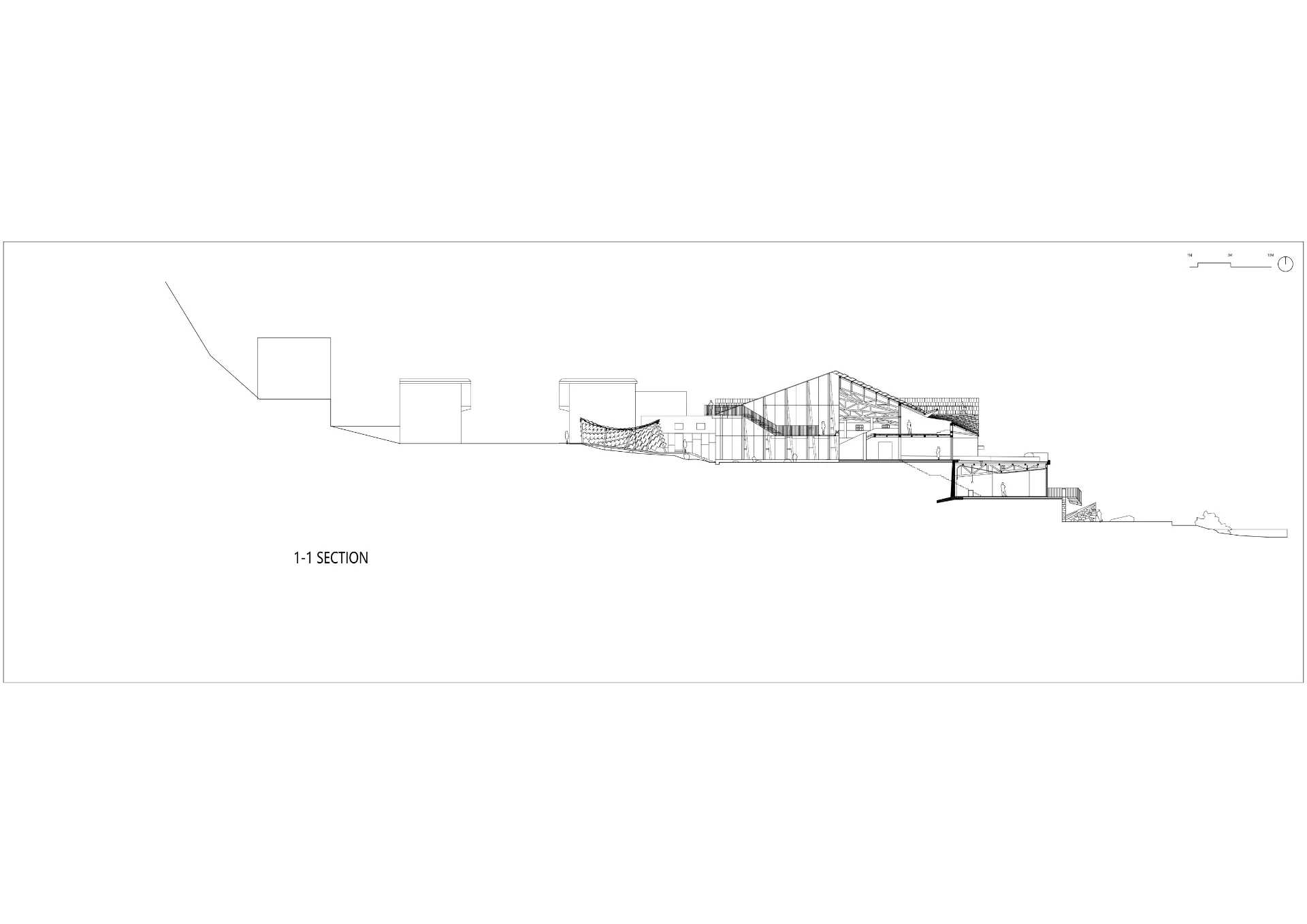
從橫向看,南側高大建築和北側舊有倉庫形成高差,新建築若組合小巧的體量,則氣勢全無;而反之則與北側倉庫難以協調。於是,美術館借南側之勢,以一片三角形曲麵包裹舊有倉庫,使其融為一體,緊接著,一筆弧線又順承倉庫屋檐,划向地面。
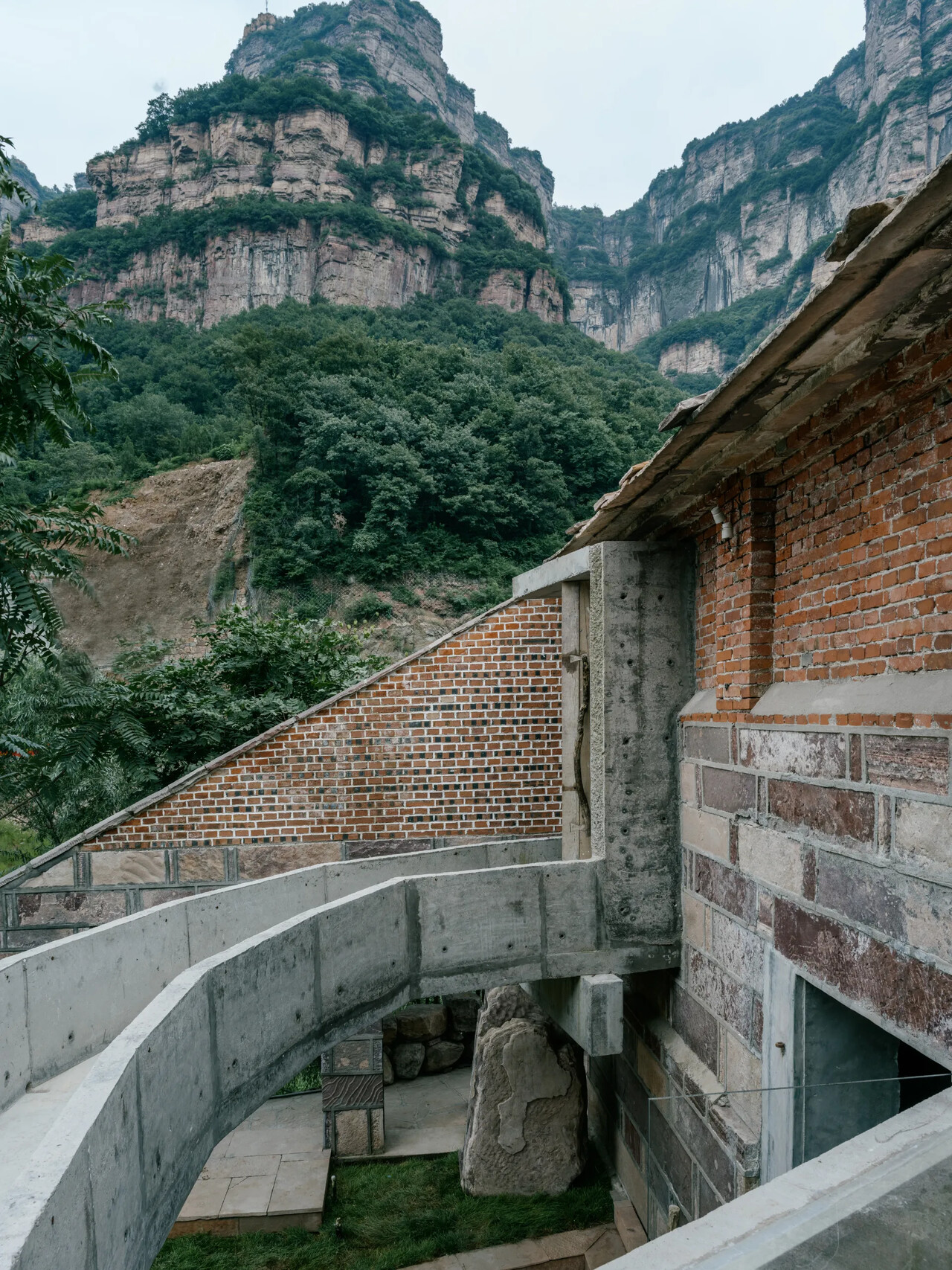
當地居民和遊客說到兩點,一是微妙的曲面和明亮的石材色澤,使其從環境中輕鬆地跳出,以「和而不同」的姿態從規整的村鎮肌理中彰顯而出,引人注目卻並未破壞大自然的美,使自然不再單調,更增加了人與自然和諧相處的靈韻。二是建築猶如從山體環境中生長而出,有機呼應,似乎已矗立生長多年,在地感強烈,其野性能夠點題太行文脈。
The interface along the river becomes the focal point of the design. From a vertical perspective, the artificial order of the square house and the natural organic order of the mountain behind it form a conflict. In other words, the art museum should coordinate the ancient mountains rushing towards us and the emerging artificial towns at the foot of the mountain. Fan Kuan of the Northern Song Dynasty's " Travelers amid Streams and Mountains " gives the answer. In the picture is high mountains, standing upright, majestic, vast, and powerful. The trail slopes through the dense forest, and the mountain trails and streams form an intricate volume. We define the interface of the museum as the "porous" and "sloping" near mountain, and the zigzag extended zigzag path, which communicates the Cangxi River and the distant mountain, creates a sense of distance that retreats layer by layer, and triggers a sense of mystery in the high and far view profound realm.
From a horizontal perspective, there is a height difference between the tall building on the south side and the old warehouse on the north side. If the new building is combined with a small volume, it will lose its momentum; otherwise, it will be difficult to coordinate with the warehouse on the north side. Therefore, taking advantage of the situation on the south side, the art museum wraps the old warehouse with a triangular surface to make it integrated. Then, an arc follows the eaves of the warehouse and draws to the ground.
Local residents and tourists mentioned two points, one is the subtle curved surface and bright stone color, which make it easily jump out of the environment, and stand out from the regular texture of the village and town with a gesture of "harmony but difference", which is eye-catching But it does not destroy the beauty of nature, makes nature no longer monotonous, and adds to the aura of harmonious coexistence between man and nature. The second is that the building seems to grow out of the mountain environment, echoing organically, as if it has been standing and growing for many years, with a strong sense of place, and its wildness can touch the context of Taihang.
與古為新的石材營造
如同鎮名所傳遞的,長久以來,石板岩人與石為伴。由於缺乏耕地,圍堰梯田經壘石而成,是山地區域長存的農業景觀,而以石塊為牆、石板為頂的村屋至今仍多有存續;鎮裡的老一輩們曾經「愚公移山」,參與建設紅旗渠人工天河;而石材建造的工藝更是從明清延續至今,吃苦耐勞的樸實民風使林州成為全國建築之鄉和重要的建築勞務基地。
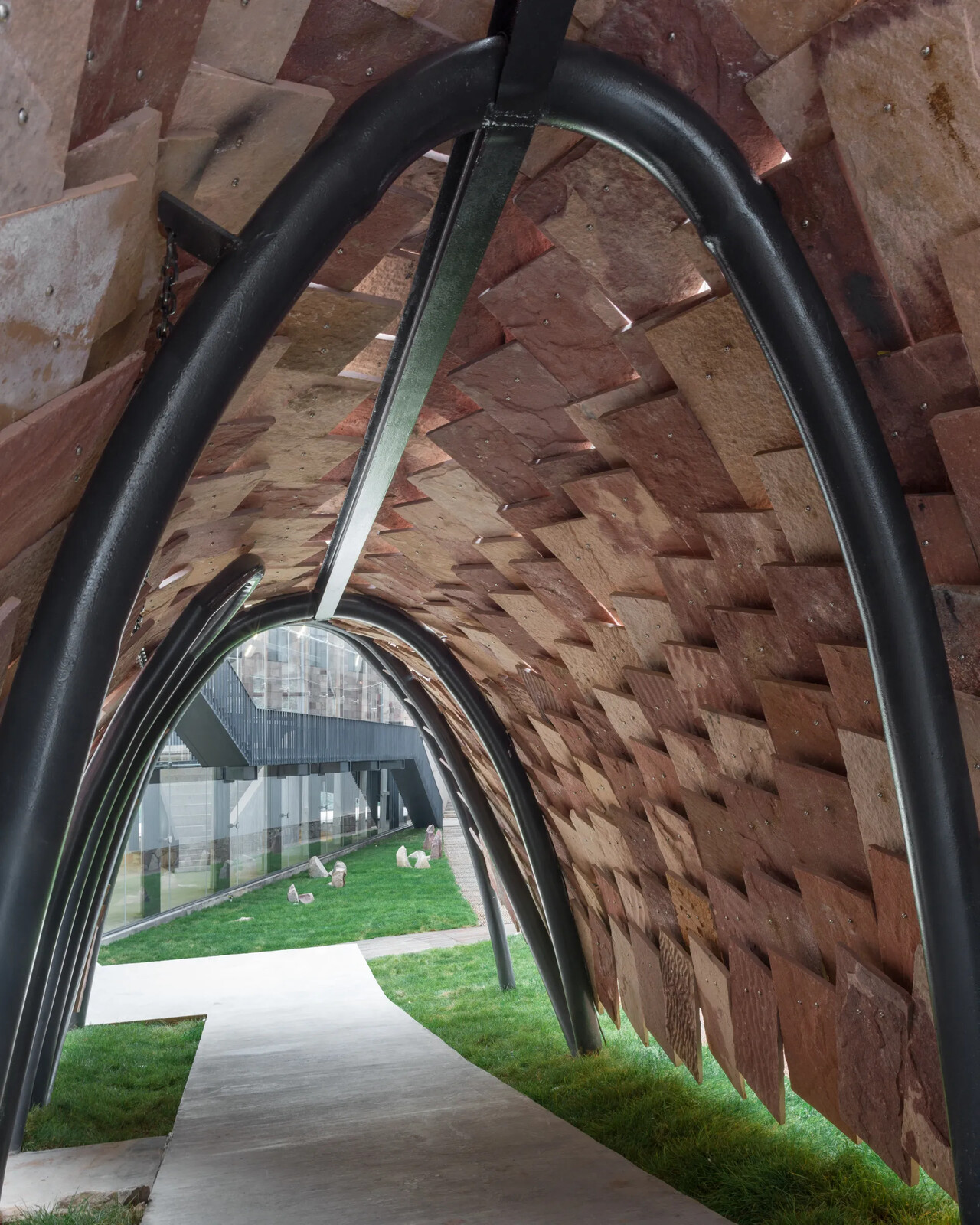
然而,受到商品經濟和廉價建造的衝擊,當下石板岩鎮的建築往往放棄了石材營造技藝,轉而採用簡省的濕粘面材包裹框架結構的立面。我們試圖將高效的鋼結構建造和傳統石材技藝進行融合,這並非是一種單純的實驗,更是基於文旅品牌塑造的考慮。
從圖像傳播的角度,石板和石塊既是建築材料,也成為展示的媒介。實驗性的石材構造做法基於當地傳統的延續和低成本建造的現實需求,體現了一種降低材料和資源消耗的可持續設計方法,在地性的工法也重塑了簡約質樸的日常生活美學。
Building with the ancient stone for the new
As the name of the town conveys, for a long time, Shibanyan people and stone have been companions. Due to the lack of arable land, cofferdam terraces are formed by laying stones, which is a long-standing agricultural landscape in mountainous areas, and many village houses with stone walls and stone slabs as the roof still exist today; the older generations in the town once " Moved Mountains", participated in the construction of the Red Flag Canal Artificial Tianhe; and the craftsmanship of stone construction has continued from the Ming and Qing Dynasties to the present, and the simple and hard-working folk customs have made Linzhou the hometown of construction in the country and an important construction labor base.
However, under the impact of the commodity economy and cheap construction, the current buildings in Shibanyan Town often abandon the stone construction skills, and instead use simple wet-bonded surface materials to wrap the facade of the frame structure. We try to integrate efficient steel structure construction with traditional stone techniques. This is not a simple experiment, but is based on the consideration of cultural tourism brand building.
From the perspective of image communication, slates and stones are not only construction materials, but also a display medium. The experimental stone construction method is based on the continuation of local traditions and the realistic needs of low-cost construction. It embodies a sustainable design method that reduces material and resource consumption. The local construction method also reshapes the simple and rustic aesthetics of daily life.
熟悉的陌生感
現代美術館往往將藝術創作的情境與公眾觀賞情境隔離開來,以疏離的白盒子氣氛營造著對藝術品的膜拜。而在小鎮的語境中,則需要塑造日常生活化的審美體驗,我們將簡約質樸的建築材料暴露,讓終日面對石頭的居民發現熟悉的陌生感,讓諸多寫生學子感受到自由開敞的交流空間,同時讓畫家孟新宇「林慮山房」牧歌般的生活方式直面觀眾,某日,當藝術家和朋友們在北邊小院子里盪鞦韆、喝茶,經過的人一起來聊聊天吧。
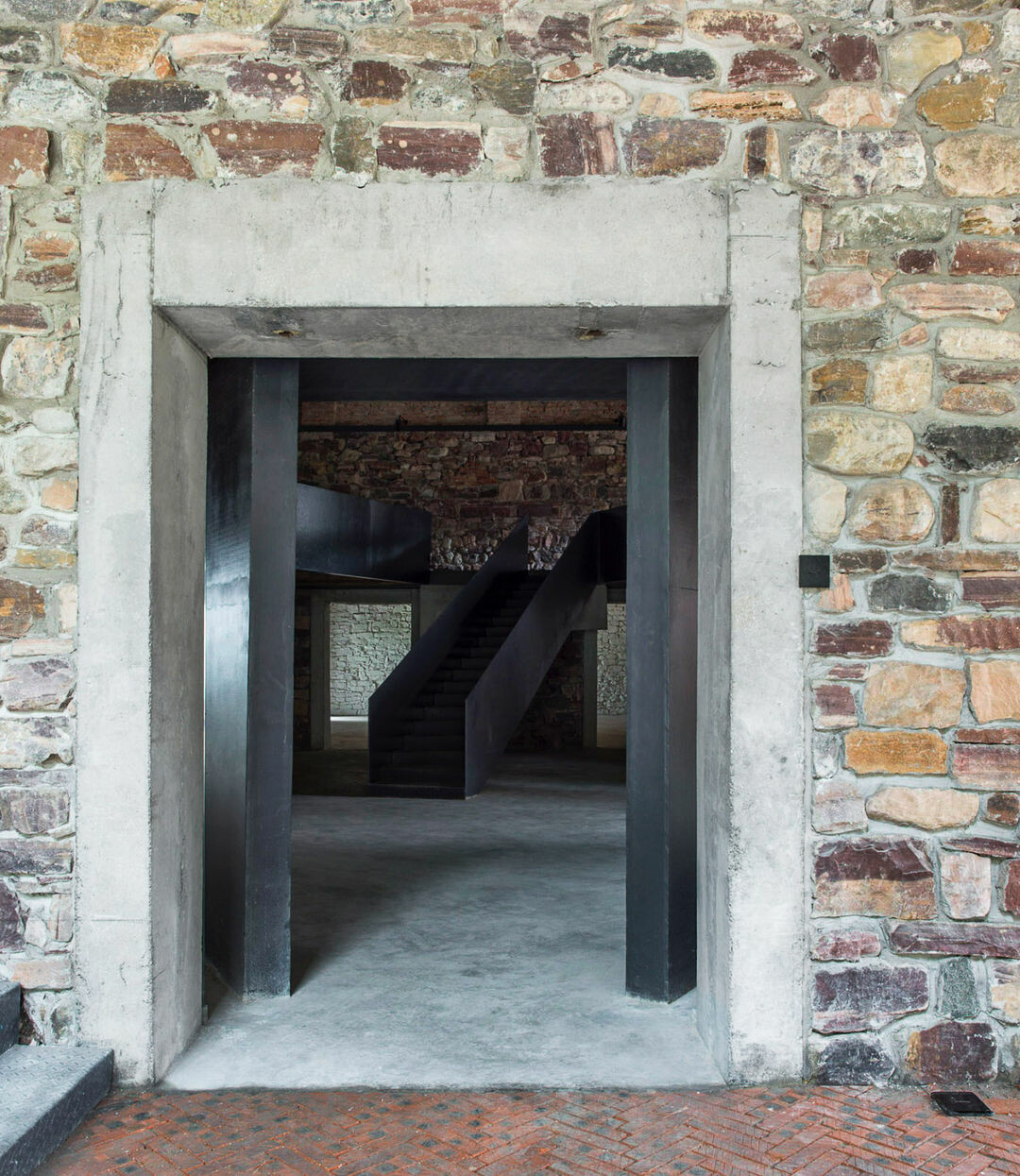
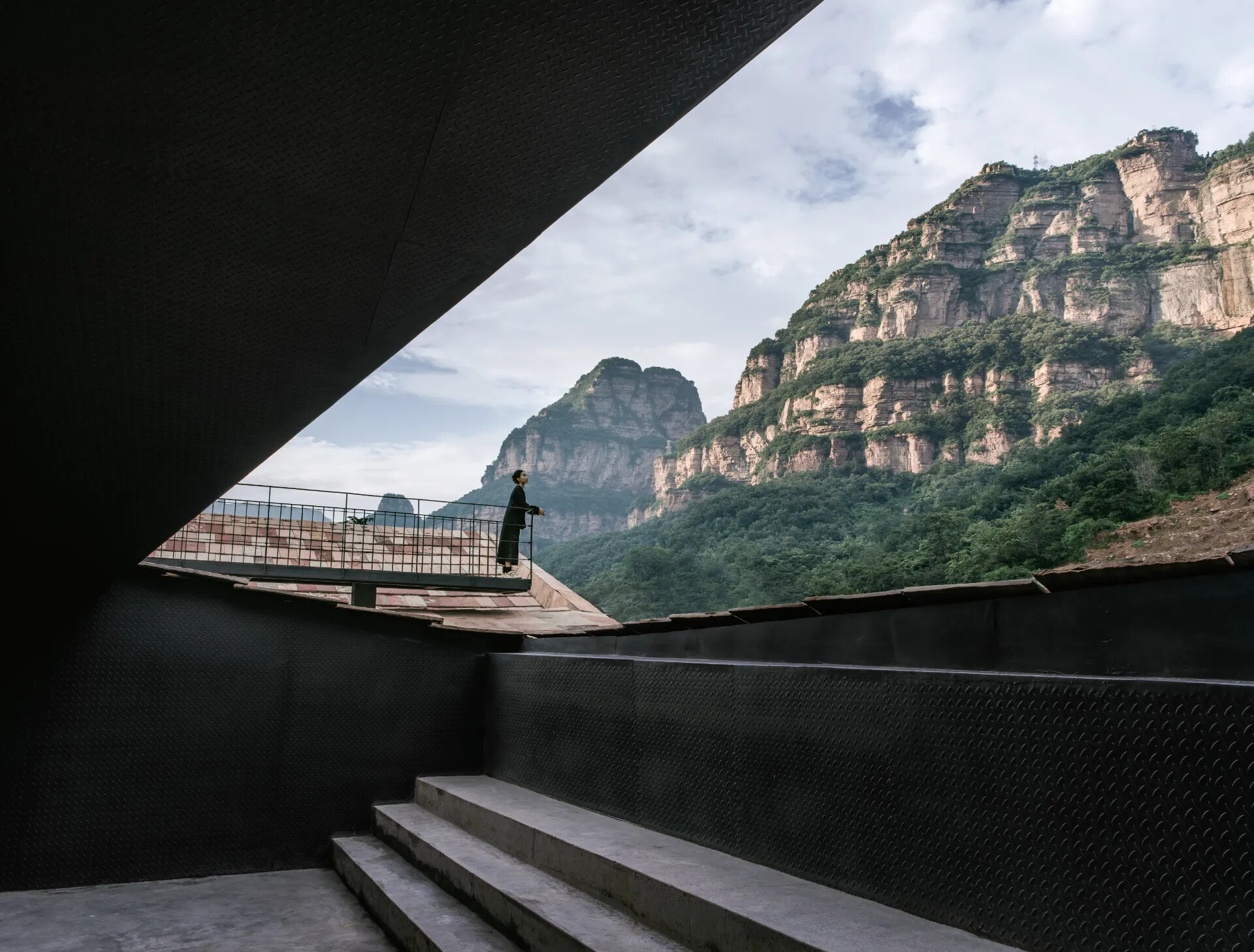
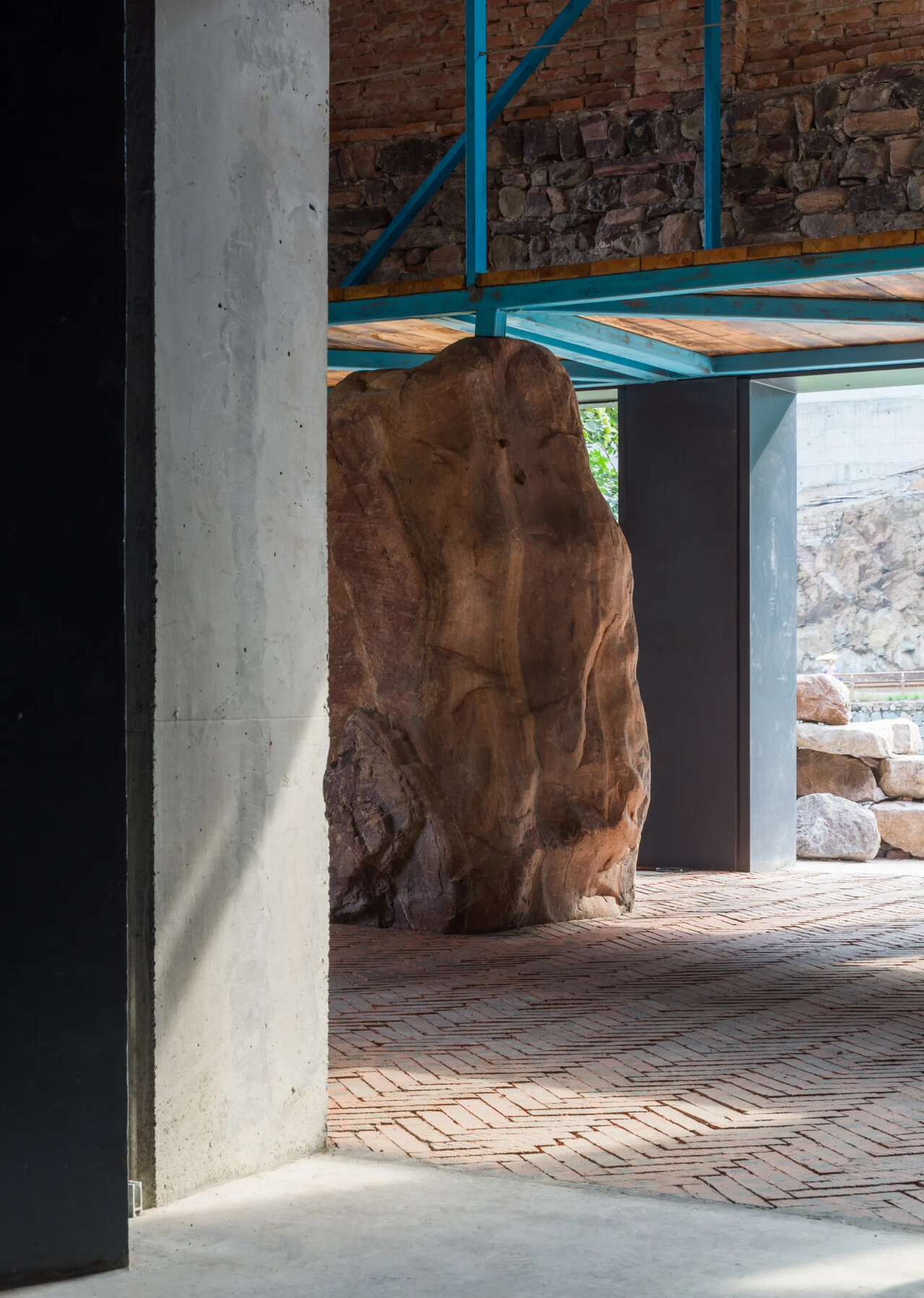
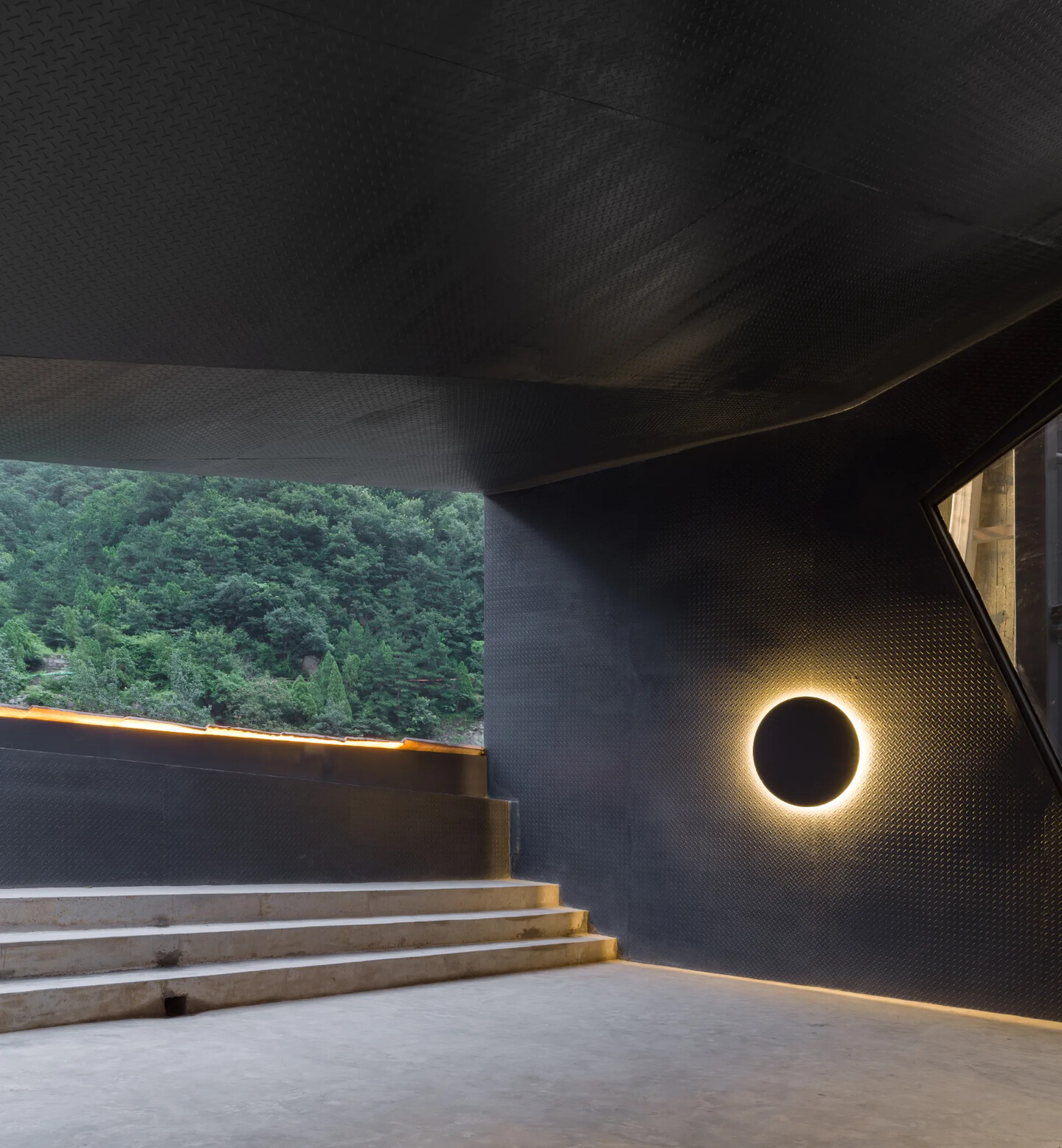
具體來說,之狀延接的步道綿延貫穿於建築立面,現代建材與本土砂岩石料交織舒展,諸多山水意象(曲巷、長橋、折道、石基、眺台、洞天、水壁)插其中,層層平台讓人擁抱自然,新舊立面交換和諧,簡約元素清新明快。步入室內,舊有倉庫被改造為展廳,自然巨石被用來支撐夾層,直率的材料表現充滿質樸之感;而作為多功能藝術展廳的新建築則裸露屋頂桁架,黑色麻繩和白色鋼材形成具有張力的空間表達;底部咖啡廳的牆面提取紅色砂岩色調,營造時尚氛圍,21平公尺的單塊落地玻璃保證了面向山水的廣闊視野。
Familiar with strangeness
Modern art museums often isolate the situation of artistic creation from the situation of public viewing, and create a worship of artworks with an alienated white box atmosphere. In the context of a small town, it is necessary to create an aesthetic experience of daily life. We expose the simple and rustic building materials, so that residents who face stones all day long find a familiar sense of strangeness, and let many sketching students feel free and open. At the same time, let the painter Meng Xinyu face the audience with the idyllic lifestyle of "Lin Lushan House". One day, when the artist and his friends are swinging and drinking tea in the small courtyard in the north, let the passers-by chat together .
Specifically, the continuous trail runs through the facade of the building, modern building materials and local sandstone materials are intertwined and stretched, and many landscape images (curved alleys, long bridges, folded paths, stone foundations, gazebos, caves, and water walls) Interspersed among them, layers of platforms make people embrace nature, the old and new facades are exchanged harmoniously, and the simple elements are fresh and lively. Stepping into the interior, the old warehouse is transformed into an exhibition hall, and natural boulders are used to support the mezzanine. It has a tense space expression; the wall of the cafe at the bottom extracts red sandstone tones to create a fashionable atmosphere, and a single piece of floor-to-ceiling glass of 21 square meters ensures a broad view of the mountains and rivers.
功能模糊的公共藝術場域
相對於精確定義用途,缺乏可變性,令人仰視的美術館,更期望在鄉土語境中實踐一種可參與的公共藝術。它成為日常生活的背景,人們交流集聚的場所,它具有多重而非單一的身份,提供自由的空間佈置,激發可能性,靈活可變,具有多重感官感受,隨著時間流逝為社群生活而逐漸打開。
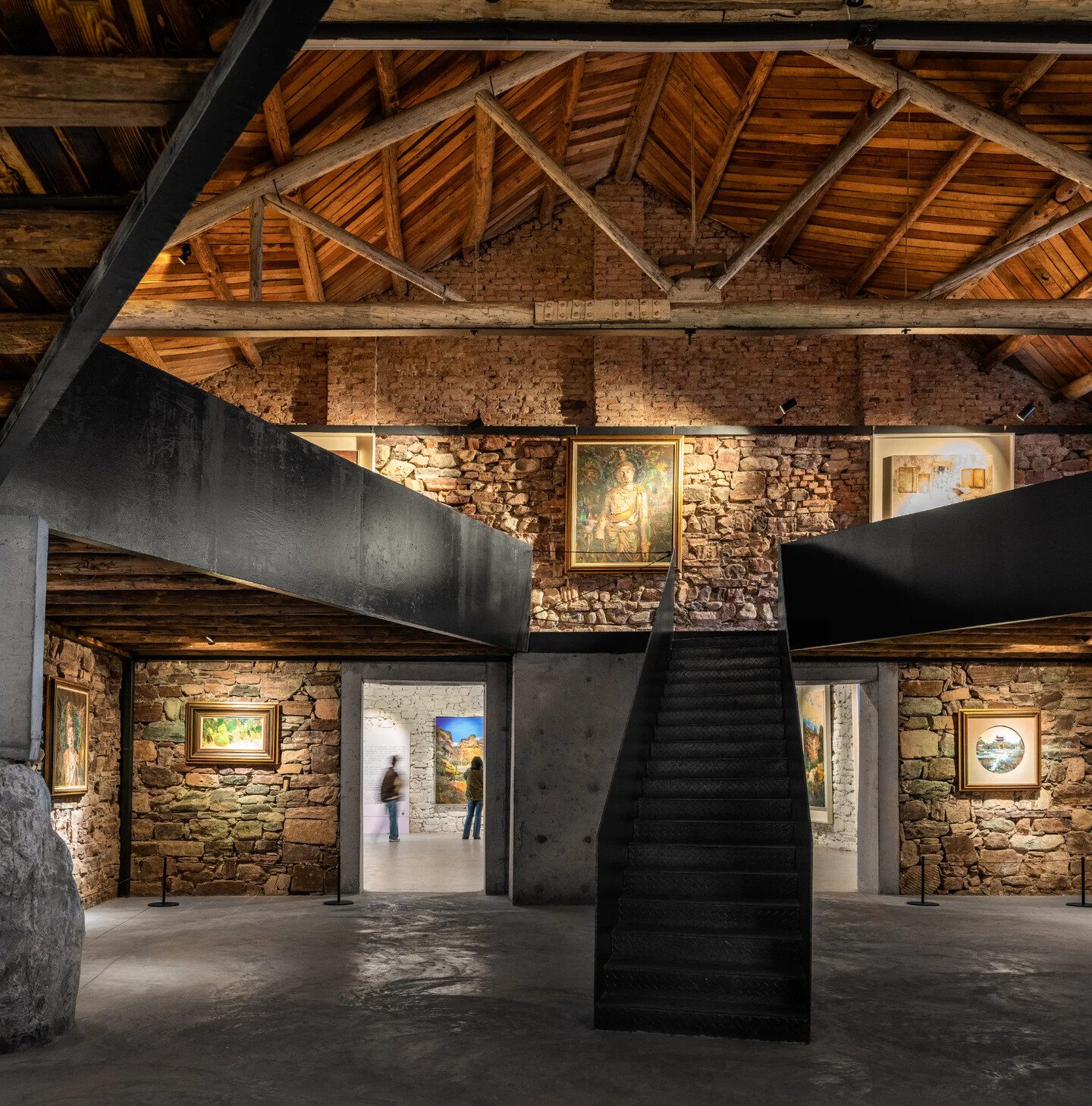
為此,室內大廳被賦予通用化的燈光設計,像是一條展廊,開展畫展,手工藝品和農產品展銷,民間傳統戲劇表演,小型會議,架上油畫展覽,藝術講座,供銷社的培訓,抑或僅 僅拜訪大量的桌椅,供人們休憩閒聊。而在倉庫展廳中,除了生活化的畫展,還佈置了藝術家工作室,模擬繪畫現場,讓藝術成為一種公共生活。
美術館的多義性更體現在室外空間,多重入口和貫穿路徑連接河岸與街道。臨水側亦設置多層級的開放平台,一、首先是鄰水的通道,承接從北側旅遊停車場到鎮上的人流;二、 在水邊通道之上的平台,夏天傍晚的咖啡座、燒烤攤方便遊客,反哺美術館運營。在白天,學生們在此寫生,孩童嬉鬧玩樂;三、餐廳屋頂成為藝術發佈會,社交活動的場所,入夜 則成為社群廣場舞的舞台。建築上的觀山露台,屋頂的游道(婚禮走廊)也賦予公共生活多重想象力。我們期待在此引發美第奇效應,一個包容性和人文關懷的公共藝術場域由此展開。
Public Art Fields with Fuzzy Functions
Compared with the precise definition of use, lack of variability, and admirable art museums, it is more expected to practice a participatory public art in a local context. It becomes the background of daily life, a place where people communicate and gather, it has multiple identities rather than a single one, it provides free space arrangement, inspires possibilities, is flexible and variable, has multiple sensory feelings, and becomes a community life over time Open gradually.